AIDR
AI-Powered Diabetic Retinopathy Screening & Explainability Platform
A clinically grounded deep learning platform that classifies diabetic retinopathy across all 5 international stages in under 2 seconds. Combines an EfficientNet-B0 CNN architecture with Grad-CAM visual attention mapping to guarantee transparent AI decision support for ophthalmologists and primary care clinics.
doctor / doctor123admin / admin123Explore AIDR Capabilities
Switch through the functional tabs below to inspect live interface mockups, algorithmic workflows, and telemetry data. Previews below feature verified and simulated test scenarios.
Rapid, Accessible Screening for Diabetic Eye Disease
Diabetic Retinopathy (DR) is the leading cause of preventable blindness among working-age adults globally. Traditional fundus exam queues take weeks and require scarce retinal specialists. AIDR provides automated screening in seconds with 94%+ diagnostic accuracy and visual Grad-CAM proof of microaneurysms and hemorrhages.
Diagnostic Workflow Advantages
The Clinical Problem: Diabetic Retinopathy Blindness
Over 537 million adults live with diabetes worldwide. Over one-third will develop diabetic retinopathy, yet 90% of severe vision loss is preventable with timely screening.
Specialist Scarcity & Bottlenecks
In rural and semi-urban clinics, ophthalmologists are in short supply. Patients wait months for basic dilated eye exams, causing avoidable vision impairment.
Black-Box AI Trust Barrier
Most commercial AI diagnostic tools output a raw percentage without explaining which retinal features drove the decision, making doctors hesitant to act on them.
Subtle Early-Stage Pathology
Stage 1 and 2 microaneurysms are microscopic (<100 microns) and easily overlooked in low-contrast fundus photography without specialized enhancement.
Disjointed Referral Documentation
Clinics lack automated systems to bridge initial screening with formal specialist referral documentation, leading to lost patient follow-ups.
The AIDR Solution: Explainable Deep Learning Screening
AIDR bridges primary care screening and ophthalmology specialists through automated, sub-2-second AI grading with Grad-CAM explainability.
EfficientNet-B0 Deep Learning Classifier
Lightweight, parameter-efficient convolutional neural network optimized for high diagnostic sensitivity across all five DR severity grades.
Grad-CAM Visual Attention Heatmap
Computes gradients of the target class score with respect to feature maps, highlighting exact lesion zones for doctor validation.
Adaptive CLAHE Image Enhancement
Normalizes uneven illumination and enhances capillary contrast before inference, ensuring robust performance across varied fundus cameras.
Automated Clinical PDF Generation
Compiles patient demographics, fundus photography, Grad-CAM maps, and referral urgency into structured medical reports.
OpenAPI-Compliant FastAPI Backend
Interactive Swagger documentation and high-throughput REST endpoints ready for EHR and hospital PACS integration.
Engineered Feature Set
Full-spectrum software architecture built for security, high throughput, and reliable real-world usage.
5-Stage Automated DR Classification
Classifies retinal scans into No DR, Mild, Moderate, Severe, or Proliferative DR with full probability distributions.
Grad-CAM Explainability Heatmaps
Visualizes neural attention directly over fundus photos, enabling doctors to verify microaneurysms and hemorrhages.
CLAHE Contrast Preprocessing
Enhances retinal vasculature and lesion visibility while suppressing camera lighting artifacts.
Automated Diagnostic PDF Reports
Generates structured, print-ready clinical reports with patient data, diagnosis, and visual proof for specialist referral.
Interactive Swagger API Documentation
Comprehensive OpenAPI REST endpoints for screening, patient lookup, and batch inference accessible live on Render.
Role-Based Doctor & Admin Portals
JWT authentication with dedicated views for clinical screening workflows and administrative system audits.
How It Works: Step-by-Step Architecture
From initial data ingestion to verified business outcomes in five automated stages.
Retinal Fundus Image Capture & Upload
The clinician captures a fundus photo using a standard desktop or portable fundus camera and uploads it via the drag-and-drop web portal.
Automated CLAHE Enhancement
The backend applies Contrast Limited Adaptive Histogram Equalization, standardizing illumination and highlighting fine retinal vascular structures.
EfficientNet-B0 Deep Inference
The preprocessed tensor passes through the fine-tuned EfficientNet-B0 model, generating softmax probabilities across all 5 clinical stages.
Grad-CAM Attention Mapping
Backpropagated gradients extract spatial activations from the final convolutional layer, rendering a color-coded attention overlay.
Clinical Review & PDF Referral Export
The physician reviews the diagnosis and visual heatmap, adds clinical notes, and downloads a formal referral PDF for the patient.
Time & Cost Impact Analysis
Quantifiable operational turnaround delivered through custom software engineering.
Comparison: Manual Legacy Workflow vs. AIDR
| Operational Capability | Without AIDR | With AIDR |
|---|---|---|
| Screening Availability | Requires on-site specialist clinic visit (weeks delay) | Immediate primary-care screening in < 2 seconds |
| Model Interpretability | Opaque probability score with no visual justification | Grad-CAM heatmap highlighting exact lesion locations |
| Image Quality Robustness | Fails on poorly illuminated or low-contrast fundus photos | CLAHE adaptive equalization standardizes quality |
| Documentation & Handoff | Handwritten notes or fragmented EHR entries | Standardized ReportLab clinical PDF with image evidence |
| API & Integration | Proprietary desktop software locked to single hardware | OpenAPI REST endpoints ready for clinic EHR integration |
Technology Stack Breakdown
Engineered with modern full-stack performance, strong typing, and production-tested libraries.
Deep Learning & Computer Vision
Convolutional neural networks fine-tuned for ophthalmic pathology classification.
Backend API & Document Engine
Asynchronous REST API with automatic OpenAPI documentation and PDF reporting.
Frontend Client Interface
Clean clinical web interface with interactive sliders, dropzones, and charts.
Deployment & Cloud Infrastructure
Decoupled modern cloud hosting with global edge delivery and Dockerized API.
Interface Showcase & User Experience
High-resolution interface captures demonstrating data density, responsive hierarchy, and clean typography.
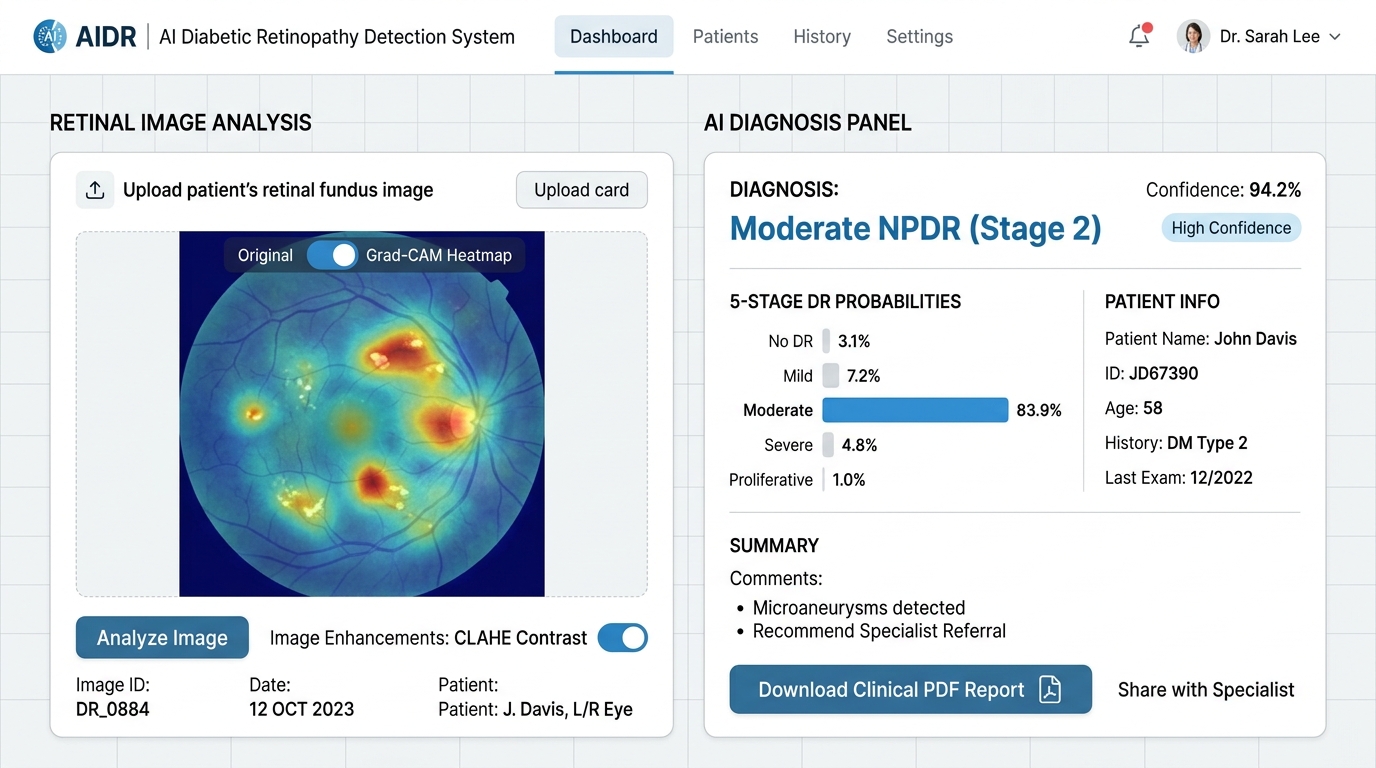
AIDR Clinical Diagnosis & Grad-CAM Heatmap Interface
Dual-panel view featuring fundus photo, Grad-CAM attention overlay, and 5-stage ICO classification.
Inspect AIDR Live
Explore the deployed web application or inspect the underlying code architecture on GitHub.
Upload patient fundus photographs, view CLAHE preprocessed scans, inspect Grad-CAM heatmaps, and generate ReportLab clinical PDFs.
System audit logs, model inference latency metrics, doctor account management, and clinical screening history.
Need a High-Performance Custom Web Application?
Whether you need an internal operations platform, an AI-powered automation workflow, or a scalable SaaS product, CORVERT designs and builds custom web applications that eliminate operational drag and deliver measurable ROI.