CuraSense AI
Healthcare Revenue Cycle Management (RCM) & Denial Prevention Platform
An enterprise healthcare revenue intelligence platform designed to eliminate the multi-billion dollar problem of payer claim denials. Cross-references claims against payer policy rules in real time, computes transparent denial risk scores, auto-drafts formal appeal letters, and ensures pre-submission billing compliance.
Direct Web Access / No Password RequiredExplore CuraSense AI Capabilities
Switch through the functional tabs below to inspect live interface mockups, algorithmic workflows, and telemetry data. Previews below feature verified and simulated test scenarios.
Stopping Healthcare Claim Denials Before They Happen
Hospitals and healthcare groups lose over $260 billion annually to payer claim denials. Traditional billing teams only react after receiving an 835 Remittance denial notice, leading to costly re-work and delayed cash flow. CuraSense shifts denial management left: inspecting claims pre-submission against commercial payer policies.
Key Platform Capabilities
The Healthcare RCM Problem: $260B in Claim Denials
Denial rates have risen to nearly 15% across US healthcare systems. Billing teams spend countless hours appealing rejected claims after the fact.
$260 Billion Lost Annually
Healthcare providers lose staggering revenue to initial claim denials, with up to 65% of denied claims never being resubmitted due to staff burnout.
45–60 Minutes Spent Per Appeal
Billing specialists spend nearly an hour digging through EHR charts, finding relevant payer policy numbers, and writing manual appeal letters.
Constantly Changing Payer Rules
Payers update coverage guidelines and prior authorization requirements constantly, creating a moving target that human billers cannot track manually.
Post-Submission Lag (30–60 Days)
Waiting for an 835 Remit denial notification creates a 30-to-60 day cash flow gap that strains healthcare operational liquidity.
The CuraSense AI Solution: Pre-Submission Denial Prevention
CuraSense prevents denials before claims reach the payer by cross-referencing clinical encounter notes with payer policies in real time.
Predictive Denial Scoring Engine
Calculates claim denial probabilities prior to transmission, highlighting specific missing codes, documentation gaps, and policy risks.
RAG-Powered Payer Policy Engine
Retrieval-Augmented Generation indexes payer coverage manuals to cross-check medical necessity and prior authorization rules.
Automated Legal Appeal Letter Generator
Synthesizes chart evidence and payer policy citations into professional appeal packages in under 10 seconds.
Compliance & Audit Protection
Identifies billing anomalies, upcoding risks, and unbundled codes to defend against post-payment payer audits.
High-Throughput asyncpg Architecture
Engineered with direct async PostgreSQL queries for sub-millisecond database lookups without ORM latency.
Engineered Feature Set
Full-spectrum software architecture built for security, high throughput, and reliable real-world usage.
Pre-Submission Denial Risk Scorer
Evaluates claim bundles against historical payer patterns and flags high-risk submissions with root-cause explanations.
RAG Payer Policy Cross-Reference
Instantly checks claims against guidelines from UnitedHealthcare, Aetna, Cigna, and Medicare to verify coverage criteria.
Instant Appeal Letter Drafting
Generates formal appeal letters citing exact chart lines, CPT/ICD pairings, and payer policy clauses in < 10 seconds.
Compliance & Upcoding Guardrails
Monitors coding complexity distributions to flag over-billing risks and unbundled procedures before payer transmission.
Synthetic FHIR EHR Ingestion
Complete mock EHR ingestion pipeline supporting FHIR Patient, Encounter, DocumentReference, and Claim resources.
Next.js App Router + FastAPI Backend
Decoupled enterprise architecture built with Next.js 16, TypeScript, Tailwind v4, and raw asyncpg PostgreSQL queries.
How It Works: Step-by-Step Architecture
From initial data ingestion to verified business outcomes in five automated stages.
Encounter & Claim Data Ingestion
The platform ingests synthetic FHIR EHR bundles including clinical notes, lab results, and proposed CPT/ICD coding.
RAG Payer Policy Cross-Referencing
The system retrieves the active medical policy guidelines for the target payer (e.g. UnitedHealthcare, Aetna) matching the submitted CPT codes.
Denial Risk Scoring & Rule Check
The engine evaluates medical necessity, documentation completeness, and modifier requirements, generating a transparent 0–100% risk score.
Pre-Submission Remediation
Billing teams receive actionable guidance to add missing documentation or adjust coding before submitting the claim to the clearinghouse.
1-Click Appeal Package Generation
If a claim was previously denied, CuraSense auto-drafts a formal, citation-backed appeal letter citing clinical evidence in under 10 seconds.
Time & Cost Impact Analysis
Quantifiable operational turnaround delivered through custom software engineering.
Comparison: Manual Legacy Workflow vs. CuraSense AI
| Operational Capability | Without CuraSense AI | With CuraSense AI |
|---|---|---|
| Denial Discovery Timing | Reactive: discovered 30–60 days later via 835 Remit | Proactive: identified pre-submission before payer transmission |
| Payer Policy Verification | Manual browsing of hundreds of payer PDF policy updates | Real-time RAG engine querying active payer guidelines |
| Appeal Letter Drafting | 30–60 minutes per appeal manually copying EHR text | < 10 seconds auto-drafting with chart & policy citations |
| Audit & Compliance Shield | Quarterly retrospective audits after clawbacks occur | Real-time detection of unbundled codes and upcoding risks |
| Database Throughput | Heavy ORM layers with slow bulk analytics | High-speed asyncpg connection pool with raw PostgreSQL queries |
Technology Stack Breakdown
Engineered with modern full-stack performance, strong typing, and production-tested libraries.
Frontend Web Application
Modern healthcare analytics dashboard built with Next.js App Router and TypeScript.
Backend REST API Engine
Asynchronous Python API with strict type validation and sub-millisecond database queries.
Database & Persistence
High-performance PostgreSQL architecture using raw asynchronous connections.
AI Intelligence & RCM Engine
Rule-based scoring, RAG policy knowledge retrieval, and automated appeal generation.
Interface Showcase & User Experience
High-resolution interface captures demonstrating data density, responsive hierarchy, and clean typography.
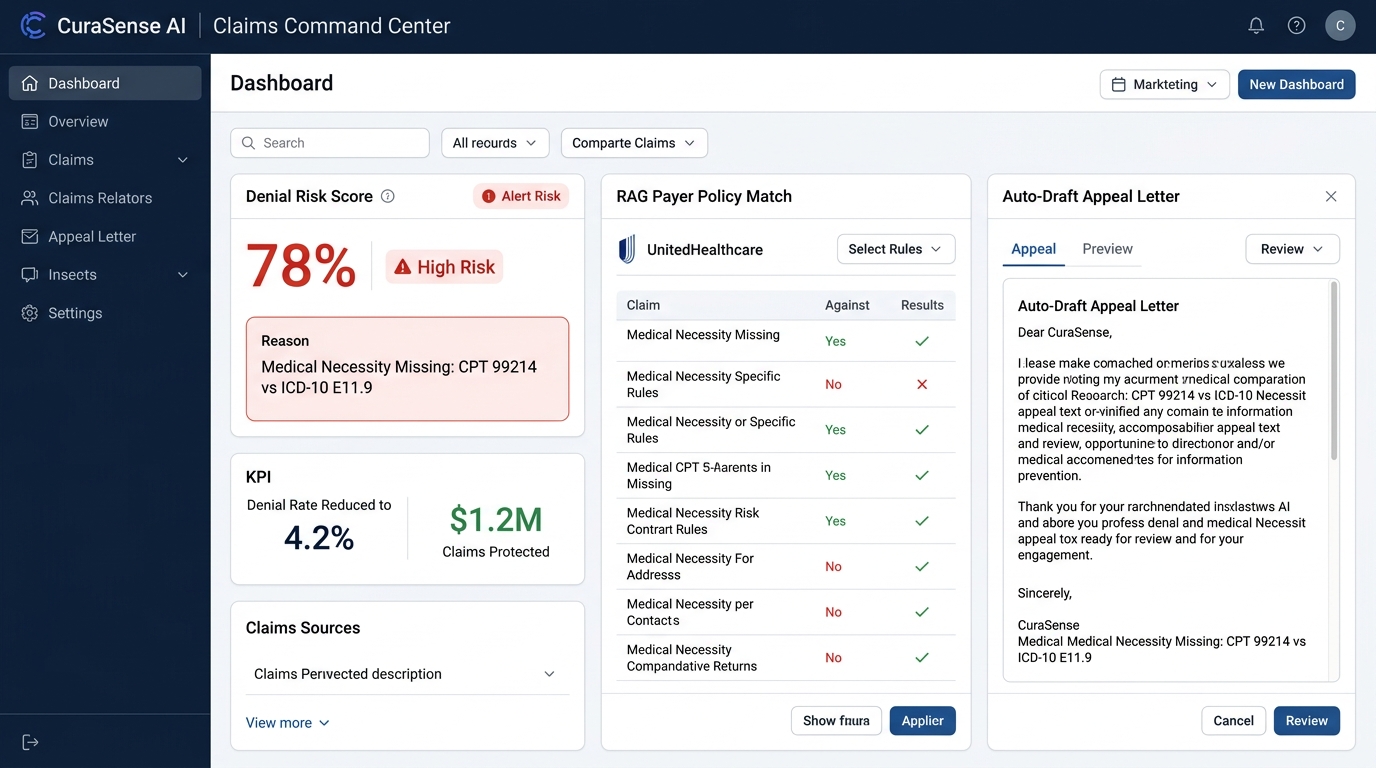
CuraSense AI Claims Command Center & Denial Risk Dashboard
Real-time claim denial risk score, UnitedHealthcare policy validation, and auto-drafted appeal letter tab.
Inspect CuraSense AI Live
Explore the deployed web application or inspect the underlying code architecture on GitHub.
Instant full-access interactive dashboard: inspect claims, review denial risk telemetry, browse payer policies, and auto-draft legal appeal letters.
Need a High-Performance Custom Web Application?
Whether you need an internal operations platform, an AI-powered automation workflow, or a scalable SaaS product, CORVERT designs and builds custom web applications that eliminate operational drag and deliver measurable ROI.